

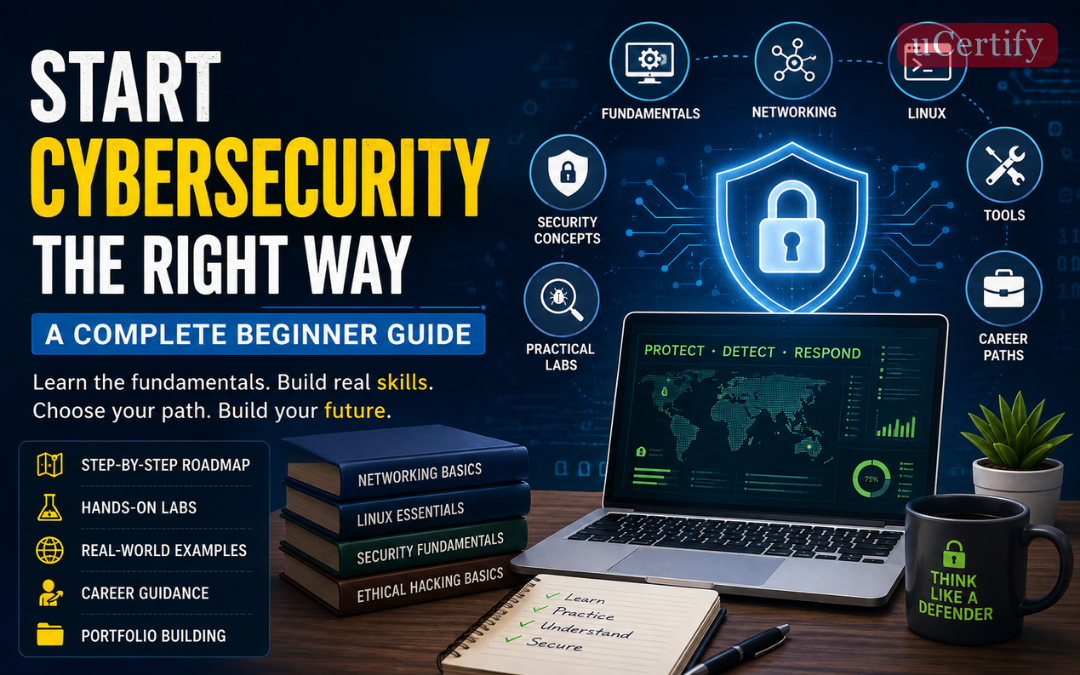
Cybersecurity can look intimidating when you’re starting out. One search leads to ethical hacking, another to penetration testing, and another to cloud security, SIEM tools, Linux, certifications, or programming. It is easy to wonder where you are actually supposed to begin.
If you want to start cybersecurity the right way, the answer is not to learn every hacking tool you can find. The better approach is to understand the technology first, build security fundamentals on top of that knowledge, and then use practical exercises to discover which part of cybersecurity interests you most.
This cybersecurity beginner guide breaks the journey into manageable stages. You will learn what foundations matter, how networking and Linux fit into security, where hands-on labs belong, how to choose a career direction, and what you can do to turn your learning into evidence of practical skill.
What Is Cybersecurity?
Cybersecurity is the practice of protecting computers, networks, applications, devices, accounts, and data from unauthorized access, misuse, disruption, or damage.
Consider something as ordinary as logging into an online account. Several security questions are involved: Is the person really who they claim to be? Does that person have permission to access the account? Is the information being transmitted securely? What happens if someone tries to access the account repeatedly with stolen credentials?
Not every cybersecurity role deals directly with authentication, suspicious access, or transmission security.
Depending on their role, cybersecurity professionals address questions like these as part of protecting systems, applications, and data.
That is why cybersecurity should not be treated as another name for ethical hacking. Penetration testing is one part of the field. Security operations, network security, application security, cloud security, incident response, digital forensics, identity and access management, and governance are other important areas.
The first lesson for a beginner is therefore simple: cybersecurity is a broad discipline, not a single job or tool.
Why Fundamentals Come Before Hacking Tools
Imagine opening a network scanner for the first time and seeing several open ports. You may know which command produced the result, but can you explain what those ports represent, which services are using them, whether they need to be exposed, and why one might deserve investigation?
That difference—between operating a tool and understanding its output—is what makes fundamentals important.
Cybersecurity depends heavily on knowledge of operating systems, networks, applications, authentication, permissions, and data. Tools are built to help you investigate or manage those technologies; they do not replace an understanding of them.
For this reason, a beginner who spends time learning how a network communicates may progress faster later than someone who memorizes dozens of commands without knowing what those commands are actually doing.
A useful rule is:
Understand the system → identify the security problem → choose the appropriate tool → interpret the result → decide what should happen next.
That sequence is much closer to real security work than simply running commands.
Step 1: Build Your Computer Fundamentals
Before diving into cybersecurity, become comfortable with the systems you are trying to protect.
Learn how operating systems organize files, manage users, run processes, allocate resources, and enforce permissions. You should understand the difference between a user account and an administrator account, why file permissions matter, and how applications interact with the operating system.
Windows is worth understanding because it is common in business environments. Linux is equally valuable because it is widely used across servers, security tooling, cloud environments, and technical infrastructure.
You don’t have to become an expert system administrator at this stage. The objective is to reach the point where basic system behavior doesn’t feel mysterious.
Beginner checkpoint
Before moving ahead, you should be able to explain:
- What an operating system does
- What a process is
- What a user account is
- Why permissions matter
- Where files and directories are stored
- How applications use system resources
If those ideas are still unfamiliar, spend more time here. A strong foundation will pay off later.
Step 2: Learn Networking Before Learning Network Security
Networking is one of the most important foundations in a cybersecurity roadmap for beginners.
Computers rarely exist in isolation. They communicate with other systems, services, applications, and users. Security teams therefore need to understand what normal communication looks like before they can recognize something suspicious.
Begin with IP addresses, MAC addresses, routers, switches, ports, TCP and UDP, DNS, DHCP, HTTP, HTTPS, firewalls, and VPNs. You should also develop a basic understanding of the TCP/IP model and how information moves between systems.
Here is a simple example.
You type a website address into your browser. Your computer needs to determine where that website is located, establish communication with the destination, send requests, and receive responses. DNS, networking protocols, the web server, and security controls can all be involved.
Now imagine that a security analyst sees a computer repeatedly communicating with an unfamiliar external address. Without networking knowledge, that event is just another line in a log. With networking knowledge, the analyst can begin asking useful questions about the destination, protocol, port, timing, and behavior.
That is why networking is not just another topic to memorize. It is part of the language of cybersecurity.
Beginner checkpoint
You should eventually be able to answer questions such as:
What is an IP address? What is a port? What is DNS responsible for? How is TCP different from UDP? What does HTTPS add to ordinary HTTP communication?
If you can explain those ideas in your own words, you are moving in the right direction.
Step 3: Learn Linux for Cybersecurity
Linux deserves a place in your early learning plan.
Rather than trying to memorize a huge command list, focus on tasks you can actually use. Navigate directories, create and inspect files, search for information, manage permissions, examine running processes, work with users and groups, and understand basic services and logs.
As your confidence improves, explore SSH, shell scripting, networking commands, and system logs.
The reason this matters is practical. During security work, you may encounter a Linux server, investigate a suspicious process, inspect a log, check a service, or review file permissions. Being comfortable at the command line removes a major barrier.
A useful practice exercise
Create a legal practice environment using a virtual machine. Create a few users, assign different permissions, create files with different access settings, and then examine what each user can and cannot access.
You are not just learning Linux commands in this exercise. You are seeing how access control works in practice.
Step 4: Understand Core Cybersecurity Fundamentals
With the computing and networking foundation in place, move into core cybersecurity fundamentals.
A good starting point is the CIA Triad:
Confidentiality means information should only be available to authorized parties.
Integrity means information should remain accurate and protected from unauthorized modification.
Availability means systems and information should remain accessible when legitimate users need them.
Consider a company’s customer database. If an unauthorized person reads customer records, confidentiality has been compromised. If someone changes account information without authorization, integrity is affected. If employees cannot access the database because the service is unavailable, availability becomes the problem.
From there, build your understanding of authentication, authorization, encryption, hashing, access control, vulnerabilities, threats, risks, malware, phishing, social engineering, and security policies.
Do not treat these as isolated vocabulary words. Learn how they connect.
For example, authentication answers “Who are you?” while authorization asks “What are you allowed to do?” A system can authenticate a user correctly and still give that user inappropriate permissions.
That distinction becomes important in identity and access management, application security, cloud security, and many other areas.
Step 5: Learn How Cyberattacks Work
A cybersecurity professional needs to understand attacks without necessarily becoming an attacker.
Start with common attack categories such as phishing, malware, password attacks, denial-of-service attacks, social engineering, and exploitation of software vulnerabilities.
The goal is to understand the chain of events.
Suppose an employee receives a convincing phishing message. The employee follows a malicious link and enters credentials into a fake login page. Those credentials may then be used to access another service.
There are several security questions hidden inside that single scenario:
- How could the phishing message have been identified?
- Was multi-factor authentication enabled?
- Could suspicious login activity have been detected?
- Were the user’s permissions limited?
- Did the organization have monitoring in place?
- What should happen after the account is compromised?
This is the type of thinking that turns cybersecurity from a collection of definitions into a problem-solving discipline.
You should also understand the difference between a vulnerability and an exploit.
A vulnerability is a weakness that could be abused. An exploit can also refer to code, commands, or a sequence of actions that takes advantage of a vulnerability. An exploit is code, a technique, or a sequence of actions used to take advantage of a vulnerability.
Step 6: Practice With Cybersecurity Labs
Theory gives you vocabulary. Practice shows you whether you actually understand it.
That makes cybersecurity labs an important part of the learning process.
Use systems specifically designed for training: virtual machines, intentionally vulnerable applications, sample packet captures, simulated networks, and other authorized environments.
A beginner lab might look like this:
Objective: Understand network discovery.
Environment: Your own isolated practice network.
Task: Identify the systems that belong to your lab, examine the services they expose, research what those services do, and document anything that deserves further investigation.
The important part is what happens after the tool produces its output.
Ask:
What did I discover? Why does it matter? Is the result expected? What evidence supports my conclusion? What would a defender do next?
Keep a record of your work. Write down the objective, environment, commands or methods used, observations, findings, and lessons learned.
This habit will become useful later when building a cybersecurity portfolio.
Step 7: Learn a Small Set of Security Tools
Once the fundamentals begin to make sense, tools become much easier to learn.
You may encounter tools such as Wireshark for network traffic analysis, Nmap for network discovery and security auditing, Burp Suite for web application testing, and SIEM platforms for security monitoring.
Do not turn this into a race to collect tools.
For example, learning Wireshark is more useful when you understand what a packet represents and why a particular protocol is being used. Learning Nmap becomes more meaningful when you understand ports, services, and network communication.
A simple learning cycle works well:
Learn the concept → use the tool → interpret the output → investigate the result → document what you learned.
The tool should answer a security question. It should not become the question itself.
Step 8: Explore Cybersecurity Career Paths
Once your foundation is developing, begin exploring different cybersecurity career paths.
You don’t have to choose a specialization immediately. Instead, pay attention to the type of problems you enjoy solving.
| Career Path | Useful Foundations | Typical Focus | Good Fit For |
| SOC / Security Operations | Networking, logs, security fundamentals | Monitoring and investigating alerts | People who enjoy investigation |
| Penetration Testing | Networking, Linux, web security | Finding and validating weaknesses | People interested in offensive security |
| Application Security | Web technologies, programming, security | Finding and reducing application risks | People who enjoy coding and web technology |
| Cloud Security | Networking, cloud platforms, IAM | Protecting cloud infrastructure and services | People interested in cloud technology |
| Digital Forensics | Operating systems, filesystems, investigation | Collecting and analyzing digital evidence | Detail-oriented investigators |
| GRC | Risk, controls, policies, compliance | Managing organizational security requirements | People who prefer risk and process |
These paths overlap, so your first job does not permanently determine your future.
A learner interested in SOC work may later move into incident response. Someone starting with networking may move into cloud security. Someone interested in web development may discover application security.
Think of your first specialization as a direction, not a lifetime commitment.
Step 9: Develop Skills Beyond Technical Knowledge
Cybersecurity work involves more than technical commands.
Imagine finding a serious vulnerability in an organization’s application. Discovering the issue is only part of the job. Someone may need to explain what is vulnerable, how significant the risk is, what evidence supports the finding, and what should be fixed.
That requires communication and documentation.
Develop skills in:
- Analytical thinking
- Troubleshooting
- Technical writing
- Communication
- Documentation
- Attention to detail
- Research
- Problem-solving
- Continuous learning
These skills can make a noticeable difference when you move from learning exercises to professional work.
Step 10: Should Beginners Get Cybersecurity Certifications?
Certifications can provide structure, especially when you are unsure what topics to study next. They can also demonstrate knowledge in a particular area.
However, certification should support your learning rather than become the entire learning strategy.
A certificate alone cannot demonstrate how you investigate an unfamiliar alert, interpret network traffic, document a vulnerability, or explain a security issue.
A stronger approach is:
Study → practice → build evidence → review weak areas → pursue the certification.
Choose a certification according to your experience and intended career direction rather than simply selecting the most popular name you see online.
If you are still learning networking and operating systems, an advanced offensive-security certification may not be the most productive first step.
Step 11: Build a Cybersecurity Portfolio
A portfolio gives you somewhere to show what you can actually do.
It does not have to be complicated.
A beginner portfolio might include a documented network-analysis exercise, a Linux permissions lab, a sample log investigation, a vulnerability report from an authorized training environment, or a security checklist for a small test system.
For every project, explain:
Objective: What were you trying to understand?
Environment: What systems or training setup did you use?
Process: What did you investigate?
Finding: What did you discover?
Lesson: What would you do differently next time?
This structure turns a collection of screenshots into evidence of problem-solving ability.
A Practical Cybersecurity Roadmap for Beginners
Instead of trying to finish cybersecurity in a few weeks, use milestones.
Month 1: Computer and Networking Foundations
Focus on operating systems, users, permissions, files, processes, IP addresses, ports, DNS, TCP/UDP, HTTP/HTTPS, and basic networking.
Milestone: Explain how a device communicates with a web service and identify the major components involved.
Month 2: Linux and Security Fundamentals
Work with Linux commands, permissions, users, processes, services, and logs. At the same time, study the CIA Triad, authentication, authorization, encryption, hashing, vulnerabilities, threats, and risks.
Milestone: Build a small Linux lab and explain how permissions affect access.
Month 3: Security Tools and Analysis
Begin working with tools such as Wireshark and Nmap in authorized environments. Learn how to interpret their output rather than simply reproduce commands.
Milestone: Complete and document at least two practical security exercises.
Month 4: Explore Specializations
Try introductory exercises related to SOC analysis, web security, cloud security, penetration testing, or digital forensics.
Milestone: Identify two areas you enjoy and compare the skills each requires.
Month 5: Portfolio Development
Turn your best exercises into clear project write-ups. Include objectives, methods, findings, screenshots where appropriate, and lessons learned.
Milestone: Have several projects that you can confidently explain to another person.
Month 6: Career Preparation
Choose a direction, identify relevant certifications or additional training, strengthen weak technical areas, and begin exploring entry-level opportunities.
Milestone: Be able to explain not only what you have studied, but what you have actually practiced.
The timeline is flexible. Someone studying several hours every day may move faster, while someone learning alongside a full-time job may need longer. The sequence matters more than the calendar.
Common Mistakes Cybersecurity Beginners Should Avoid
Trying to Learn Everything
Cybersecurity is too broad to master all at once. Jumping between penetration testing, cloud security, malware analysis, digital forensics, and compliance can leave you with shallow knowledge of each.
Build a foundation first, then explore.
Collecting Tools Instead of Skills
Having a security distribution installed does not make someone a security professional. The useful skill is knowing what problem a tool solves and how to interpret its output.
Watching Without Practicing
Tutorials can make a topic feel familiar without proving that you can use it independently.
After learning a concept, close the tutorial and try to reproduce the task in your own authorized environment.
Chasing Certifications Too Early
A certification can validate knowledge, but it cannot substitute for understanding. If the underlying concepts are weak, advanced certification preparation becomes unnecessarily difficult.
Practicing Against Systems Without Permission
Cybersecurity skills should be developed in environments where you have explicit authorization. Your own lab, intentionally vulnerable training systems, and authorized platforms provide safer places to experiment.
Understanding the legal and ethical boundaries is itself part of becoming a cybersecurity professional.
Start Cybersecurity the Right Way
The right starting point for cybersecurity is not the most advanced tool, the longest certification list, or the flashiest hacking technique.
It is understanding what is happening inside the technology.
Learn how computers work. Understand networks. Become comfortable with Linux. Build your security fundamentals. Practice in controlled environments. Learn tools when you have a reason to use them. Then explore different career paths and build evidence of your skills.
If you remember only one idea from this guide, make it this:
Don’t measure your cybersecurity progress by how many commands you can run. Measure it by how well you can explain what happened, why it matters, and what should happen next.
That shift—from memorizing actions to understanding problems—is what turns beginner study into meaningful cybersecurity skill.
Frequently Asked Questions
Can I start cybersecurity with no IT experience?
Yes. A beginner can enter the field without professional IT experience, but basic computer and networking knowledge will make the learning process much easier. If those areas are unfamiliar, treat them as the first stage of your cybersecurity journey rather than trying to skip ahead.
How long does it take to learn cybersecurity?
There is no universal timeline. The fundamentals can be developed over several months with consistent practice, but becoming job-ready depends on your previous experience, available study time, chosen specialization, and practical work.
The goal should not be to “finish” cybersecurity. It is a field that requires continuous learning.
Do I need programming to start cybersecurity?
Not necessarily. Some areas, particularly application security and certain offensive-security or security-engineering roles, benefit significantly from programming. Other entry-level paths may rely more heavily on networking, operating systems, monitoring, investigation, or risk management.
Basic scripting is still a valuable skill to develop as you progress.
Is ethical hacking the same as cybersecurity?
No. Ethical hacking is one specialization within cybersecurity. The broader field also includes security operations, incident response, cloud security, application security, digital forensics, identity management, governance, risk, compliance, and security engineering.
What should I learn first in cybersecurity?
Begin with computer fundamentals and networking. Add Linux and core security concepts next. After that, introduce practical labs and security tools.
A useful sequence is:
Computers → Networking → Linux → Security Fundamentals → Labs → Tools → Specialization → Portfolio
What is the best cybersecurity career for beginners?
There is no single best path for everyone. Security operations can be a useful direction for people who enjoy monitoring and investigation. Penetration testing may appeal to people who enjoy offensive security. Application security can suit people with an interest in programming and web technologies, while GRC can be a better fit for people interested in risk, policies, and compliance.
Your interests and existing skills should influence the decision.
Final Takeaway
A successful cybersecurity journey is built one layer at a time.
Learn technology. Understand the security problem. Practice safely. Document your work. Explore a specialization. Build job-ready evidence.
You do not have to know everything before you begin, and you do not have to decide your entire career on day one.
The strongest beginner is not necessarily the person who knows the most tools. It is the person who is willing to understand the fundamentals, investigate carefully, ask better questions, and keep learning.
Your cybersecurity journey doesn’t have to start with hacking. It starts with understanding how technology works—and learning how to protect it.
_(1)_0010Oy.webp)


_0013Gd.png)

No Comments Yet
Be the first to share your thoughts on this post!